صوت و تصویر
رئیسی
2026-10-29 18:50
زمان مطالعه: 9 دقیقه
بازدید: 7
—
(0)
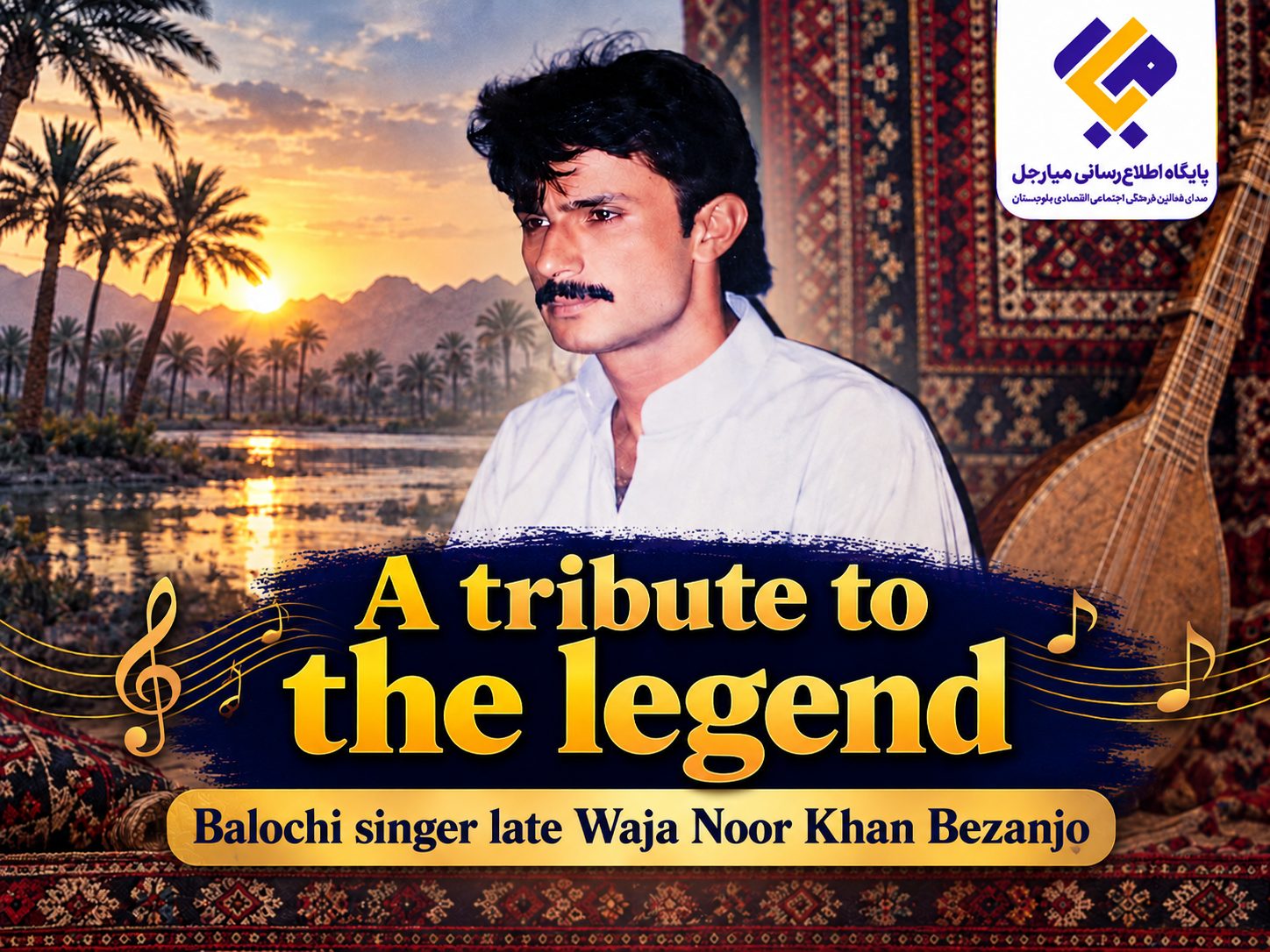
Remembering Waja Ustad Noor Khan Bezanjo: The Timeless Voice of Balochi Music
More than two decades have passed since the untimely death of Waja Ustad Noor Khan Bezanjo, yet his voice continues to echo through the hearts of Balochi music lovers. Some artists are remembered for their achievements, others for the emotions they inspire. Noor Khan Bezanjo belonged to that rare generation of musicians whose artistic brilliance transcended their lifetime, leaving behind a legacy deeply woven into the cultural memory of Balochistan.
Born on January 9, 1970, in Pasni, Balochistan, Noor Khan Bezanjo was the son of Ghulam Sarwar Bezanjo. From an early age, he demonstrated an exceptional interest in both education and music, two passions that would eventually shape his remarkable journey.
He completed his matriculation in Pasni before moving to Karachi, where he pursued his higher secondary and undergraduate education. His academic ambitions later took him to Quetta, where he earned a Master of Arts degree in History from the University of Balochistan. He was regarded as the first Balochi singer to have obtained a master's degree in History, a distinction that reflected his intellectual curiosity and commitment to learning.
His student years also brought him into contact with political and social activism. While pursuing his education, he joined the Baloch Students Organization (BSO), becoming involved in the political consciousness and aspirations of his community.
Music, however, had captivated his imagination long before he entered university.
As a schoolboy in Pasni, Noor Khan began exploring the world of melody and rhythm. His first formal introduction to music came under the guidance of Ustad Ejaz Ali Baloch, who taught him the fundamentals of the art. When he moved to Karachi, he continued his training under Ustad Mohammad Omar and later benefited from the musical knowledge and experience of Ustad Abdul Sattar Baloch.
These early influences helped him develop a distinctive musical identity, combining technical understanding with a naturally expressive voice. His singing possessed an emotional depth that could communicate feelings of love, separation, longing, and belonging with extraordinary sensitivity.
In 1988, Noor Khan began performing at Balochi musical gatherings, gradually establishing himself as a promising young artist. It was during this period that he met Waja Ustad Arif Baloch, another accomplished singer celebrated for his melodious voice and memorable compositions.
Their meeting would become one of the defining moments of Noor Khan's musical career.
What began as a professional association soon developed into a profound friendship and an exceptional artistic partnership. Together, Noor Khan and Arif Baloch recorded numerous songs and albums, performed duets, and appeared at cultural and musical events. Their voices complemented one another, creating performances that captivated audiences and earned lasting admiration.
Their friendship extended far beyond the stage. Built on mutual respect, artistic understanding, and personal affection, it became an enduring example of companionship within the Balochi musical community.
As Noor Khan's reputation grew, his music began travelling beyond the geographical boundaries of Balochistan. His songs found enthusiastic audiences in Sindh, Iran, Oman, Bahrain, and the United Arab Emirates. Alongside Arif Baloch, he received invitations to perform at musical programmes in Gulf countries, introducing his distinctive style to Balochi communities living abroad.
Despite his growing popularity, Noor Khan remained deeply connected to the musical traditions that had shaped him.
Among the artists he admired most were Mureed Buledai, Nusrat Fateh Ali Khan, and Abida Parveen. His favourite poet was Mubarak Qazi, whose literary expression resonated with his own artistic sensibilities.
His closest companions included Arif Baloch and Ustad Rasool Bakhsh Fareed, a respected singer and accomplished musician known for his mastery of the banjo and harmonium. Fareed frequently accompanied Noor Khan during performances, and the three artists shared a close friendship rooted in their common dedication to Balochi music.
Noor Khan was not merely a gifted vocalist. He was also a poet and composer who understood music as a powerful expression of cultural identity. His artistic approach brought traditional and contemporary musical elements into conversation, helping preserve the emotional richness of classical Balochi music while introducing new dimensions to its presentation.
His voice was his greatest gift: naturally beautiful, unmistakably distinctive, and capable of conveying profound emotions without excessive ornamentation. Through his singing, he gave musical expression to the experiences, memories, hopes, and sorrows of his people.
Although his career was tragically brief, Noor Khan recorded and released ten albums: Sherkani Yaat (Lovely Memories), Ost (Trust), Umeet (Hope), Qandeel a Rok Kan (Turn On the Light), Zaheerani Raazan (Secret Memories), Mehar Pah Nam Ent (Love for Name), Jetai (Separation), Gazan, Sheer Mahe Shap (Night of the Full Moon), and Addenk (Mirror).
His first album, Sherkani Yaat, marked the beginning of his recorded musical journey, while Addenk became his final album.
Beyond these ten albums, more than 200 volumes of recordings from different musical programmes and performances were released, preserving a substantial part of his artistic legacy.
Each recording carried something of his distinctive personality. His music was not simply entertainment; it was an expression of Balochi language, poetry, tradition, and collective identity.
Yet the life of this extraordinary artist was destined to end far too soon.
On August 5, 2003, Noor Khan and his close friend Arif Baloch attended a musical programme in Mand, Kech, Balochistan. They continued performing until dawn the following morning, sharing their music with an audience that could scarcely have imagined it would be among Noor Khan's final performances.
On the afternoon of August 6, 2003, Noor Khan Bezanjo passed away at Arif Baloch's guesthouse in Koshkalat, Turbat.
He was only 33 years old.
The news of his sudden death devastated his family, friends, fellow musicians, and countless admirers. He left behind his wife, two daughters, and a son, along with a musical legacy that would continue to grow in significance.
For Arif Baloch, the loss was particularly heartbreaking. Noor Khan had been far more than a fellow performer; he had been a trusted friend, an artistic companion, and an inseparable part of his musical life.
In a brief statement that captured the depth of his grief, Arif Baloch said:
“I have lost my voice.”
Few words could have expressed the emotional weight of that loss more powerfully.
In subsequent performances, whenever Arif Baloch sang songs associated with his late friend, he remembered Noor Khan with affection and admiration, acknowledging his dedication to Balochi music, literature, and culture.
Later in 2003, a memorial gathering was organised in Karachi to honour Noor Khan's life and artistic contributions. The event brought together Baloch writers, poets, singers, musicians, linguists, and intellectuals, all united in mourning the loss of a remarkable cultural figure.
Among those who paid tribute was Ustad Abdul Sattar Baloch, one of Noor Khan's music teachers. Describing his former student as a superstar, he expressed the profound sense of loss felt throughout the community:
“We regret that a great artist and superstar has been separated from us and from our entire Baloch nation.”
Poet and intellectual G. R. Mullah remembered Noor Khan as a representative voice of the Baloch people. Reflecting on the enduring nature of artistic achievement, he emphasised that artists never truly die, for their work continues to live in the hearts and memories of those they inspire.
Noor Mohammad Nooral, a respected singer, poet, composer, and music instructor, also reflected on Noor Khan's exceptional contribution. He observed that, despite having only a short period in which to develop his career, Noor Khan had accomplished as much as he could in service of his people and their cultural heritage.
His sudden death, Nooral believed, was especially painful because it deprived Balochi music of an artist whose dedication and abilities promised so much more.
In the years following Noor Khan's passing, the Balochi music industry witnessed the emergence of numerous new singers. Recording and releasing music became increasingly common, with performers of varying levels of experience entering the field.
Meanwhile, Noor Khan's recordings continued to circulate widely. Music production companies distributed his performances through cassettes, CDs, and DVDs, reportedly generating substantial sales. The enduring demand for his songs demonstrated that his connection with listeners had survived his death.
What made Noor Khan's legacy particularly remarkable was not simply the number of albums he recorded or the popularity he achieved. It was the emotional authenticity of his music and his ability to give voice to the cultural experiences of an entire community.
His songs carried the warmth of Balochi poetry, the richness of traditional melodies, and the unmistakable character of an artist deeply attached to his roots.
As of October 29, 2026, more than 23 years have passed since his death. Had he lived, Noor Khan Bezanjo would have celebrated his 56th birthday on January 9 of this year.
Time has transformed the world in which he once performed. Musical styles have evolved, recording technologies have changed, and new generations of singers have emerged. Yet his voice continues to hold a special place among those who appreciate Balochi music.
Every August 6, the anniversary of his passing offers an opportunity to remember not only the singer but also the cultural values he represented. His contributions to Balochi language, literature, and music remain an important part of the artistic heritage he helped preserve.
Among the memorable expressions attributed to Noor Khan is a message that reflects his understanding of collective responsibility and respect for one's people:
وتئ قوم ءَ گوشداراِت
وتئ قوم ءَ برداشت کن اِت
مستریں قومیت ھمیش اِیں
“Listen to your nation and tolerate them; that is the symbol of nationalism.”
These words offer a glimpse into the values that accompanied his artistic life: patience, understanding, solidarity, and a profound attachment to his community.
Noor Khan Bezanjo's journey was brief, but the legacy he created was enduring. He lived for only 33 years, yet his music has continued to inspire listeners for more than two decades after his passing.
His life reminds us that the significance of an artist cannot be measured solely by the years they live, but by the depth of the impression they leave upon the world.
For generations of Balochi music lovers, Waja Ustad Noor Khan Bezanjo remains more than a celebrated singer. He is a cherished voice of cultural memory, a symbol of artistic devotion, and an enduring part of Balochistan's musical heritage. The man departed on August 6, 2003. His voice never did.
Originally written by Sami Parvez for The Balochistan Point.



User Comments